Beauty Delya: A Graceful Script Font for Brand Identity
I was staring at a blank brand board for a new boutique skincare line when the usual suspects—those safe, overused serif and sans serif fonts—just wouldn't cut it. The client wanted something that felt handcrafted, intimate, and undeniably feminine without tipping into cliché. That is when I pulled up Beauty Delya. As soon as I typed the first few letters of the concept name, the screen seemed to clear. It wasn't just another decorative script; it had a rhythm. It felt like watching a calligrapher work in real-time, capturing that ravishing style that instantly elevates a logo draft from generic to bespoke.
The Visual Personality of Beauty Delya
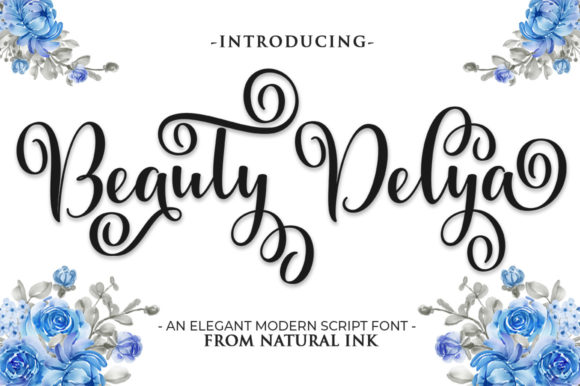
In the world of Fonts, particularly within the Script Amp category, there are many options that try too hard. They can feel stiff or overly ornate, breaking the flow of a sentence. Beauty Delya avoids this trap by maintaining a beautiful lettered structure that remains legible even with its graceful curves. It strikes a delicate balance between a modern typography system and a traditional handwritten font. When I zoomed in on the kerning, I noticed how the strokes vary in thickness, mimicking the pressure of a fine nib pen. This variation gives the typeface a living, breathing quality that static geometric scripts often lack.
One of the standout features during my initial review was the PUA encoding. For designers who know their OpenType specs, this is a game-changer. Because Beauty Delya is PUA encoded, you have direct access to all glyphs and swashes without fighting complex character maps. I found myself toggling through the alternates effortlessly, swapping standard terminals for elegant flourishes to fit the specific mood of the project. It felt less like configuring software and more like selecting tools from a well-organized kit.
Testing the Font Across Brand Touchpoints
A font might look stunning in isolation, but does it hold up in a full brand identity? To find out, I pushed Beauty Delya through a series of realistic design assets. First, I placed it on a packaging mockup for a serum bottle. The font scaled beautifully; the intricate details didn't get lost even at smaller sizes on the label. The contrast between the dark glass and the white script created a premium look that immediately suggested high-quality ingredients.
Next, I moved to digital applications. I set up a website header and an Instagram post layout. On the web, the font loaded quickly and rendered sharply across different browsers. In social media graphics, the long descenders and ascenders created natural negative space that allowed other design elements to breathe. I also tested it on a business card mockup. While I would hesitate to use it for body copy, as a headline for the contact name and title, it exuded professionalism and warmth. It told the recipient exactly what kind of experience they could expect before they even made a call.
Where Beauty Delya Shines (And Where It Doesn't)
Beauty Delya is clearly a display font designed to make an impact. It excels in logo design, editorial headers, product labels, and short phrases where elegance is the priority. Its personality is perfect for creative studios, wedding planners, artisanal bakeries, and luxury lifestyle brands. However, as a responsible designer, I must note where this typeface falls short. Do not use it for long paragraphs of body text. The intricate loops and varying stroke weights can strain the eye if used in dense blocks, making readability suffer. It is also not suitable for formal corporate environments that require a strictly neutral or industrial aesthetic. If your brand needs to communicate "tech startup" or "legal firm," this graceful script will likely clash with your message.
Furthermore, while it handles small sizes reasonably well on packaging, extreme miniaturization should be avoided. Always test your final output on the actual medium before printing thousands of units. What looks crisp on a 4K monitor might lose definition on textured paper or certain plastics.
Strategic Pairing and Typography Systems
To build a cohesive visual hierarchy, Beauty Delya needs a solid partner. In my project, I paired it with a clean, geometric sans serif font for the supporting text. The simplicity of the sans serif allowed the script to take center stage without creating visual chaos. Alternatively, a classic serif font could work well for a more traditional, editorial feel. The key is to let the script act as the accent or headline driver while the secondary typeface handles the information heavy lifting. This combination ensures that your brand identity remains both stylish and functional.
When working with the included styles, take advantage of the ligatures and swashes to create unique wordmarks. You can extend a swash to underline a tagline or connect two words in a logo lockup. These features allow you to customize the font to fit your specific layout constraints, ensuring that every project feels distinct even when using the same typeface.
Licensing and Practical Considerations
Before integrating Beauty Delya into any commercial work, always verify the licensing terms. Whether you are designing a logo for a client, creating templates for print-on-demand merchandise, or launching a new e-commerce site, ensure you have the appropriate commercial license. Using a premium font without the correct rights can lead to legal complications down the road. Most reputable foundries offer clear tiers for personal, commercial, and extended use. Check if the license covers webfont usage if you plan to embed it directly into a website via CSS.
Finally, remember that testing is non-negotiable. Download the font, install it, and run it through your entire workflow. Check how it behaves in your preferred design software, how it exports to PDF, and how it renders on mobile devices. Beauty Delya offers a ravishing style that can transform a bland concept into a lovely design, but only if applied with care and understanding of its strengths. By treating it as a versatile tool rather than a magic bullet, you can create brand identities that are not only visually stunning but also deeply effective.